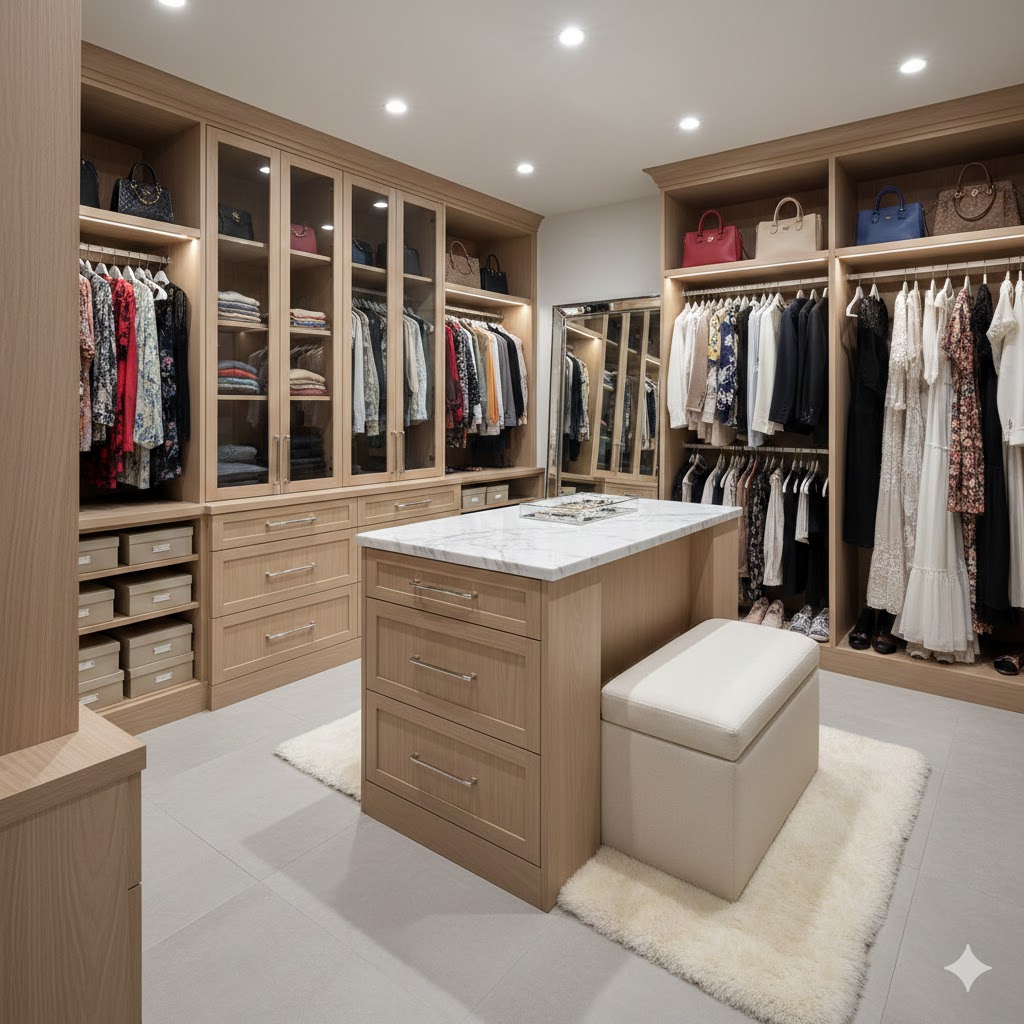
Most people start closet design by thinking about how much space they have.
That matters, of course. But the better place to start is with your daily routine.
The best custom closets are designed around real habits, not just shelves and hanging rods. If you are planning a custom closet for your home in Cumming, Alpharetta, Milton, Gainesville, or the north Atlanta area, here are a few ways to think through the design before you start picking finishes.
Start with how you actually get ready
Think through a normal morning.
Do you get dressed quickly and need everything visible? Do you plan outfits ahead of time? Do you keep work clothes, casual clothes, and special occasion pieces separate? Do you need a place to sit, fold, steam, or pack?
A good closet layout should reduce the little annoyances that slow you down. That might mean more short hanging space for shirts and pants, a dedicated section for shoes, drawers for workout clothes, or open shelves for items you reach for every day.
The goal is simple: when you open the closet, the things you use most should be easy to see and easy to reach.
Count what you own before designing the layout
Before choosing a closet system, take inventory.
You do not need a perfect spreadsheet, but you should know the basics:
- How many long hanging items you have, like dresses, coats, or gowns
- How much short hanging space you need for shirts, jackets, skirts, and pants
- How many pairs of shoes you want stored in the closet
- Whether you prefer drawers, baskets, shelves, or hanging storage
- What needs to be hidden versus displayed
This step keeps the design practical. If you own two long dresses but 40 pairs of shoes, your closet should not be built around long hanging space. If you fold most of your clothes, drawers and shelves may matter more than rods.
Custom closet design works best when it starts with your real wardrobe.
Separate daily items from occasional items
Not everything deserves prime space.
The clothes, shoes, and accessories you use every week should be the easiest to access. Seasonal items, formalwear, luggage, keepsakes, and rarely used pieces can go higher, lower, or farther back.
This is where custom storage makes a big difference. Adjustable shelves, double hanging sections, pull-out accessories, drawers, valet rods, and upper cabinets can help every item find the right place.
A closet feels calmer when the daily routine is not competing with everything you only use twice a year.
Use vertical space wisely
Many builder-grade closets waste vertical space. There may be one shelf and one rod, with a lot of unused room above and below.
A custom closet can use that height more efficiently.
Double hanging sections can instantly create more usable storage for shirts, pants, and jackets. Upper shelves can hold bins, handbags, hats, or seasonal pieces. Tall sections can be reserved for dresses, coats, or ironing boards.
The trick is not to fill every inch just because you can. The closet still needs breathing room. But when vertical space is planned well, even a smaller closet can feel much larger.
Think about visibility
If you cannot see something, you probably will not use it.
Open shelving works well for shoes, handbags, folded denim, sweaters, and display items. Drawers are better for things that can look messy out in the open, like socks, undergarments, workout clothes, and accessories.
Some people love everything tucked away. Others want a boutique-style closet where favorite pieces are visible. There is no one right answer. The right design depends on how you like to live.
Plan for shared closets
If two people share a closet, the design should give each person a clear zone.
That does not always mean splitting the closet exactly in half. One person may need more hanging space while the other needs more drawers or shoe storage. The important thing is that each person has a defined area that fits their wardrobe.
Shared closets become frustrating when everything blends together. Separate sections make the space easier to maintain.
Do not forget the small details
The best closet designs usually come down to details.
A valet rod gives you a place to hang tomorrow's outfit or dry cleaning. A jewelry drawer keeps accessories from tangling. A hamper cabinet keeps laundry off the floor. Good lighting helps you actually see colors and textures. Soft-close drawers make the space feel more finished.
These are not just upgrades for looks. They make the closet easier to use every day.
Choose materials that fit your home
Closet finishes should feel connected to the rest of the house.
A clean white system can make a smaller closet feel bright and open. Wood tones can add warmth. Matte finishes feel modern. Decorative hardware can tie the closet into nearby bathrooms or bedrooms.
For homes in the Atlanta area, especially newer builds and renovated homes, many homeowners want closets that feel less like utility storage and more like an extension of the primary suite.
That does not mean the design has to be overdone. Simple, well-planned materials often age better than trendy choices.
Leave room for life to change
Your closet should work now, but it should not be so rigid that it only works for this exact moment.
Adjustable shelves and flexible sections are helpful because wardrobes change. Kids grow. Jobs change. Seasons shift. People move from office wear to work-from-home clothes, or the other way around.
A good custom closet gives you structure without boxing you in.
A better closet starts with a better conversation
The most useful closet design questions are not just about measurements. They are about habits.
What drives you crazy about your current closet? What ends up on the floor? What do you reach for every morning? What do you wish had its own place?
Once those answers are clear, the design becomes much easier.
If your closet looks full but still does not work, it may not be a space problem. It may be a design problem. And that can be fixed.
Ready to design a closet around your routine?
Closets By Tara designs custom closet systems for homeowners in Cumming, Alpharetta, Milton, Roswell, Johns Creek, Buckhead, East Cobb, and the greater Atlanta area.
Book Free Consultation